law of areas
Học thuậtThân thiện
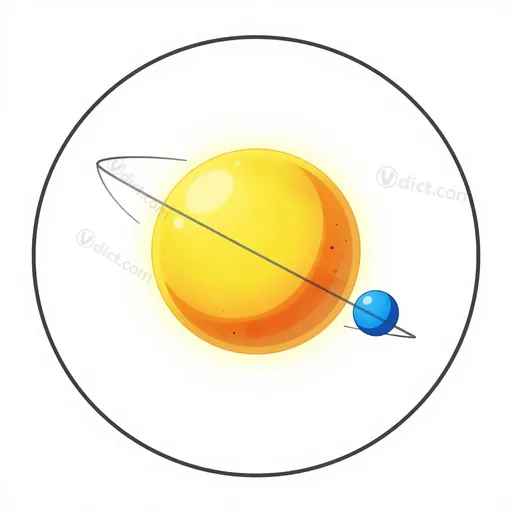
A planet moves faster when it is closer to the sun, according to the law of areas.
Definition
Noun: - A principle in celestial mechanics: The "law of areas" states that for a planet orbiting the sun, the line joining the planet to the sun sweeps out equal areas in equal intervals of time. This describes how a planet's orbital speed varies based on its distance from the sun.
Usage
- This term is used specifically in the context of astronomy and physics to describe planetary motion.
- It is often introduced when discussing Kepler's laws of planetary motion.
Examples
Advanced Usage
- In mathematical formulations: The law is a consequence of the conservation of angular momentum. It can be expressed as , where is the area swept out.
- The law of areas is mathematically equivalent to the statement that angular momentum is conserved for a planet in orbit.
Variants and Related Words
- Kepler's second law: This is the most common alternative name for the law of areas.
- Law of equal areas: A less common but equivalent phrasing.
Synonyms
- Kepler's second law (of planetary motion): The direct synonym, named after the astronomer Johannes Kepler who formulated it.
Related Concepts (Not Phrasal Verbs or Idioms)
- Kepler's first law: The law of orbits, stating planets move in elliptical paths with the sun at one focus.
- Kepler's third law: The law of periods, relating the orbital period of a planet to the semi-major axis of its orbit.
- Conservation of angular momentum: The fundamental physics principle underlying the law of areas.
A planet moves faster when it is closer to the sun, according to the law of areas.
Noun
- a law concerning the speed at which planets travel; a line connecting a planet to the sun will sweep out equal areas in equal times
- Kepler's second law means that a planet's orbital speed changes with its distance from the sun