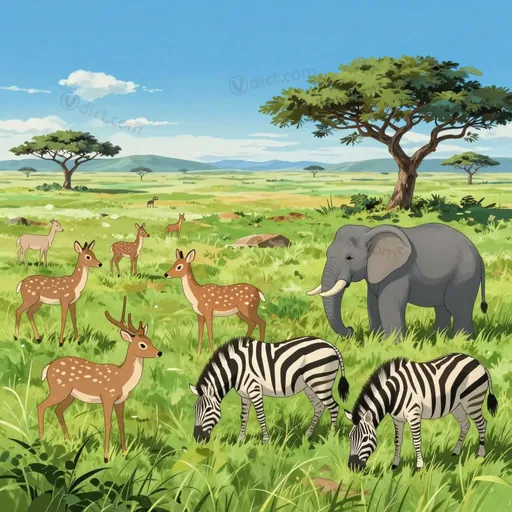
herbivora
Definition
- Noun (plural):
- Herbivorous mammals collectively: "herbivora" refers to a group of animals, specifically mammals, that feed primarily on plants. It is a taxonomic or descriptive term used in zoology to denote plant-eating quadrupeds, such as cows, deer, and horses.
Usage Examples
- (The grassland contains many plant-eating mammals.)
- (The plant-eating mammals are identified by their dental features.)
Advanced Usage
- "herbivora" as a scientific classification: In older zoological systems, "herbivora" was used as a suborder or group within mammals, distinct from carnivora (meat-eaters) and omnivora (mixed-diet animals).
- The term herbivora is less common today, replaced by "herbivore" for individual species. (The collective noun is now rarely used in modern taxonomy.)
Variants and Related Words
- Herbivore (n): an individual animal that eats plants.
- A rabbit is a herbivore. (A rabbit eats only plants.)
- Herbivorous (adj): feeding on plants.
- The herbivorous diet of the cow consists mainly of grass. (The cow's plant-based food.)
- Herbivory (n): the act or process of feeding on plants.
- Herbivory can affect plant growth in an ecosystem. (Plant-eating behaviour influences vegetation.)
Synonyms
- Plant-eaters: animals that consume vegetation.
- Phytophages: a scientific term for organisms that eat plant matter (from Greek "plant" + "to eat").
- Phytophages include many insects and mammals. (Plant-eating organisms.)
Related Idioms
- (No common idioms involve "herbivora" directly; however, the concept appears in ecological contexts.)
- In the food chain, herbivora are primary consumers. (Plant-eating animals occupy the second trophic level.)
Notes on Usage
- "Herbivora" is a plural-only noun; it does not have a singular form. For a single animal, use "herbivore."
- This term is primarily scientific or historical; in modern English, "herbivores" (plural) or "herbivorous animals" is more common.