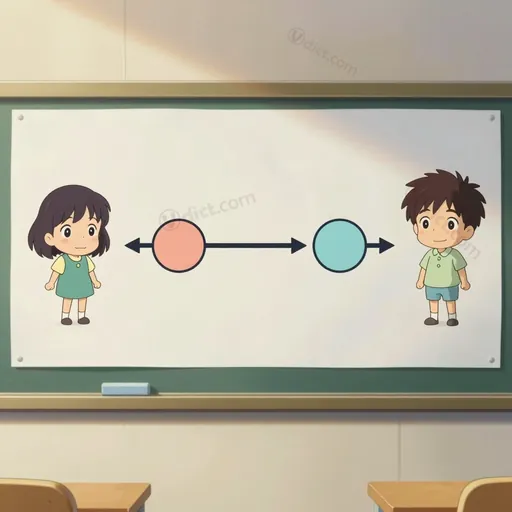
temporal relation
Definition
Noun: A connection or association between events, states, or points that is based specifically on their position in time. It describes how one thing is situated in time relative to another.
Usage
This term is used to describe the chronological relationship between two or more events or points in time. It is a formal term common in linguistics, philosophy, logic, and narrative analysis. - It is often analyzed in terms of sequence (before, after, simultaneous), duration, and frequency. - In grammar, it can refer to the relationship expressed by verb tenses.
Examples
- In the sentence "She left before he arrived," the word "before" establishes a between the two actions.
- The study of narrative focuses on the between the order of events in the story and their order in the plot.
- Philosophers examine the of cause and effect.
Advanced Usage
- In Logic and Computing: Temporal relations are formalized in temporal logic to reason about statements whose truth values depend on time (e.g., "It will always be the case that..." or "Until event A happens, B is true").
- In Linguistics: The field of tense and aspect is fundamentally concerned with expressing between the time of speaking, the time of the event, and other reference times.
Variants and Related Words
- Temporal (adjective): Relating to time as opposed to eternity, or relating to secular life as opposed to spiritual.
- Relation (noun): The way in which two or more concepts, objects, or people are connected.
Synonyms
- Time relationship
- Chronological connection
- Sequential order
Related Phrases and Concepts
- Temporal Logic: A formal system for representing and reasoning about propositions qualified in terms of time.
- Temporal Ordering: The sequence in which events occur.
- Anteriority: The relation of occurring before in time.
- Posteriority: The relation of occurring after in time.
- Simultaneity: The relation of occurring at the same time.
Noun
- a relation involving time