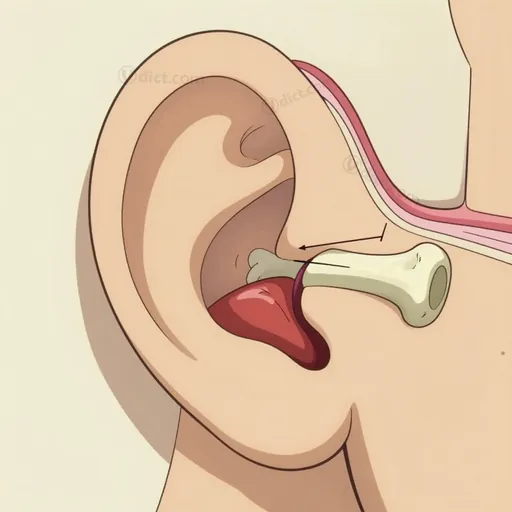
tensor tympani
Noun: A small muscle located within the middle ear. Its primary function is to contract (tense) in response to loud sounds or certain actions like chewing or speaking, thereby reducing the vibration of the eardrum (tympanic membrane) to help protect the inner ear from potential damage.
The term "tensor tympani" is used in anatomical, medical, and audiological contexts to refer specifically to this muscle and its function. - The tensor tympani is one of the two muscles in the middle ear. - An involuntary spasm of the tensor tympani can cause a rumbling sound in the ear. - Doctors study the tensor tympani reflex to understand certain hearing disorders.
- Tensor Tympani Syndrome: A condition characterized by frequent, often involuntary, contraction of the tensor tympani muscle, leading to symptoms like ear fullness, tinnitus, and hyperacusis (sensitivity to sound).
- She was diagnosed with tensor tympani syndrome, which explained her sensitivity to everyday noises.
- Stapedius Muscle: The other, even smaller muscle in the middle ear that works in conjunction with the tensor tympani as part of the acoustic reflex.
- Tympanic Membrane: The technical term for the eardrum, which the tensor tympani muscle acts upon.
- Acoustic Reflex / Stapedius Reflex: The involuntary muscle contraction of both the stapedius and tensor tympani muscles in response to loud sound.
There are no direct common-language synonyms for this specific anatomical term. In technical descriptions, it may be referred to as: - The tympanic tensor muscle (a fuller anatomical name).
- Tensor tympani contraction: The specific action of the muscle tightening.
- A sudden tensor tympani contraction can be triggered by a very loud noise.
- Tensor tympani reflex: The protective, involuntary contraction of the muscle.
- The tensor tympani reflex helps dampen the sound of your own voice when you speak.
- a small muscle in the middle ear that tenses to protect the eardrum