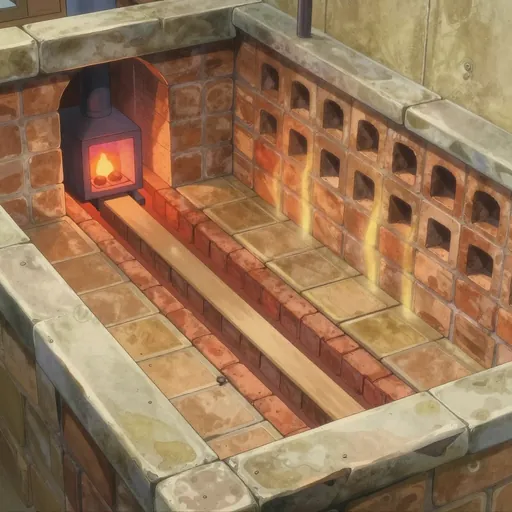
hypocaust
Definition
- Noun:
- Ancient Roman heating system: "hypocaust" refers to an underfloor heating system used in ancient Roman buildings, where hot air from a furnace circulated through a space beneath the floor and often within the walls to heat rooms, especially baths.
Usage Examples
- Noun:
- The Roman bath complex featured a sophisticated hypocaust that kept the water warm. (The underfloor heating system maintained the bath temperature.)
- Archaeologists discovered the remains of a hypocaust beneath the villa's floor. (The heating structure was found below ground level.)
Advanced Usage
"Hypocaust system": the complete arrangement of furnace, flues, and floor cavities.
- The hypocaust system in the Roman bathhouse required constant maintenance by slaves. (The entire heating infrastructure needed regular care.)
"Hypocaust chamber": the hollow space under the floor where hot air flows.
- The hypocaust chamber was built with brick pillars to support the floor above. (The cavity was constructed with support columns.)
Variants and Related Words
Hypocaustal (adj): relating to or characteristic of a hypocaust.
- The hypocaustal design allowed efficient heating of large public spaces. (The heating method was effective for big rooms.)
Hypocaustum (n, Latin origin): the Latin term for hypocaust, sometimes used in historical texts.
- The hypocaustum was a key innovation in Roman architecture. (The Latin word is used in scholarly contexts.)
Synonyms
- Underfloor heating: a modern term for a similar heating method.
- Radiant floor heating: a contemporary system that heats floors via water or electric coils.
Related Idioms
- (No common idioms exist for this specialized term.)
Phrasal Verbs
- (No phrasal verbs are associated with this noun.)