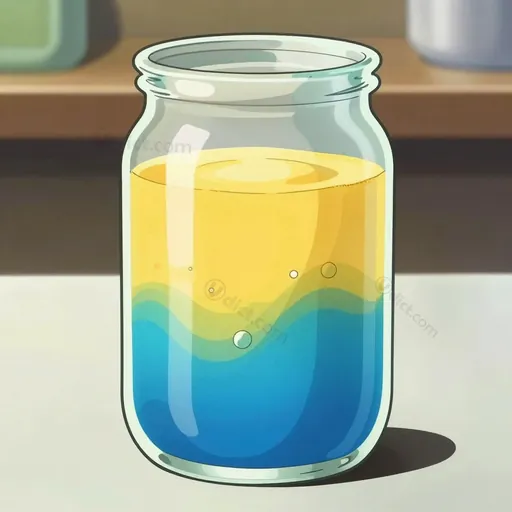
immiscibility
Definition
- Noun:
- The quality or state of being incapable of mixing: "immiscibility" refers to the property of two or more substances that do not blend or combine to form a homogeneous mixture. This term is most commonly used in chemistry and physics to describe liquids, but it can apply to other materials as well.
Usage Examples
- (The two liquids cannot mix together.)
- (The substances remained distinct and did not combine.)
- (The metals could not blend into a single phase.)
Advanced Usage
"Immiscibility gap": A range of compositions or conditions in which two substances are immiscible, often observed in phase diagrams.
- The phase diagram shows a wide immiscibility gap for the liquid mixture. (A region where the components do not mix.)
"Partial immiscibility": A state where substances are miscible only within certain proportions or temperatures.
- At room temperature, the system exhibits partial immiscibility. (Some mixing occurs, but not complete.)
Variants and Related Words
Immiscible (adj): not capable of being mixed.
- Oil and water are immiscible liquids. (They do not mix.)
Miscibility (n): the ability to mix (opposite of immiscibility).
- The miscibility of ethanol and water is high. (They mix easily.)
Synonyms
- Non-miscibility: the inability to mix.
- Incompatibility: lack of ability to combine (used more broadly, not only for liquids).
Antonyms
- Miscibility: the ability to mix.
- Solubility: the ability to dissolve (a related but distinct concept).
Related Idioms
"Like oil and water": describing two things that do not mix or get along.
- Their personalities are like oil and water — complete immiscibility. (They cannot coexist harmoniously.)
"Separate like oil and water": to remain distinct and not blend.
- The two groups separate like oil and water, showing their immiscibility. (They stay apart.)