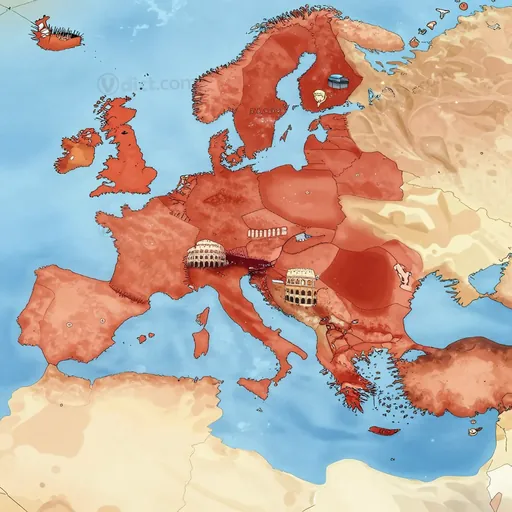
roman empire
Definition
- Proper noun:
- The Roman Empire: A major historical empire established in 27 BC by Augustus, the first Roman emperor. It succeeded the Roman Republic and, at its greatest extent, controlled vast territories around the Mediterranean Sea, including parts of Europe, North Africa, and Western Asia. It was formally divided into the Western Roman Empire and the Eastern (Byzantine) Empire in AD 395.
Usage
- The term Roman Empire is used to refer to the period of ancient Roman history following the Republic, characterized by imperial rule.
- It is used in historical, political, and cultural contexts to discuss the empire's administration, legacy, and fall.
Examples
Advanced Usage
- "The Holy Roman Empire": A later, different political entity in central Europe (800/962–1806 AD) that considered itself a successor to the ancient Roman Empire. It was not contiguous with the original Roman Empire.
- Voltaire famously remarked that the Holy Roman Empire was "neither holy, nor Roman, nor an empire."
- "Pax Romana": Refers to the long period of relative peace and stability (approx. 27 BC to 180 AD) within the Roman Empire.
- The Pax Romana facilitated trade and cultural exchange across the empire.
Variants and Related Words
- Roman (adj): Of or relating to ancient Rome or its empire.
- Roman architecture; Roman law.
- Imperial (adj): Relating to an empire or emperor.
- Imperial authority; imperial expansion.
- Byzantine Empire (n): The eastern continuation of the Roman Empire after the division, lasting until 1453 AD.
- Western Roman Empire (n): The western half of the divided empire, which ceased to have a recognized emperor in 476 AD.
Synonyms
- Ancient Rome (when referring to the imperial period).
- The Empire (in a clear historical context).
Related Phrases
- "The fall of the Roman Empire": A common historical phrase referring to the collapse of imperial authority in the West in the 5th century AD.
- The fall of the Roman Empire is a classic topic of historical study.
- "Bread and circuses" (): A phrase describing a Roman strategy of appeasing the public with food and entertainment to maintain political stability.
- Some critics accuse modern governments of using a policy of bread and circuses.
Idioms
- "To fiddle while Rome burns": To be negligently idle during a crisis or disaster. This idiom alludes to the (likely apocryphal) story of Emperor Nero playing the lyre during the Great Fire of Rome in 64 AD.
- The CEO seemed to be fiddling while Rome burned as the company's stock price plummeted.
Noun
-
an empire established by Augustus in 27 BC and divided in AD 395 into the Western Roman Empire and the eastern or Byzantine Empire; at its peak lands in Europe and Africa and Asia were ruled by ancient Rome
Khám phá thêm
Các từ liên quan
Từ đồng nghĩa
Từ chứa "roman empire"