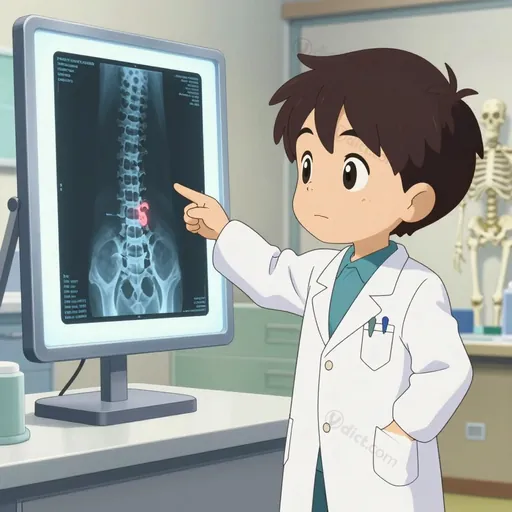
schistorrhachis
Noun: A congenital defect characterized by a malformation of one or more vertebrae. This condition is considered not uncommon. When only a few vertebrae are involved and there is no accompanying myelomeningocele (a severe neural tube defect), the condition often presents with few or no noticeable symptoms. It can be detected prenatally through amniocentesis.
This is a highly specialized medical term used primarily in clinical, anatomical, and genetic contexts. It is not used in everyday conversation.
Examples: - The prenatal screening revealed a case of schistorrhachis in the developing fetus. - Unlike spina bifida cystica, a simple schistorrhachis involving a single vertebra may be asymptomatic.
The term is used in differential diagnosis to describe a specific type of vertebral malformation distinct from more severe neural tube defects.
- Rachischisis: A more general term for a congenital cleft in the vertebral column, which may encompass schistorrhachis.
- Spina bifida occulta: A related, often mild form of spinal dysraphism where the vertebral arch is incomplete but the spinal cord and meninges are not exposed.
- Vertebral cleft (a descriptive, non-technical synonym)
- Spinal dysraphism (a broader category of defects)
The core meaning refers specifically to a malformed vertebra. It is crucial to distinguish it from open neural tube defects where the spinal cord or meninges are exposed, as schistorrhachis, in isolation, typically has a much better prognosis.
-
a not uncommon congenital defect in which a vertebra is malformed; unless several vertebrae are affected or there is myelomeningocele there are few symptoms; can be diagnosed by amniocentesis
Khám phá thêm
Các từ liên quan
Từ đồng nghĩa