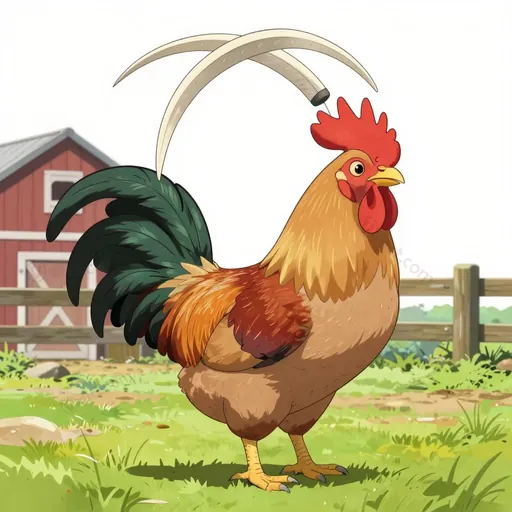
sickle-feather
Definition
- Noun:
- A specific tail feather in certain birds: "sickle-feather" refers to one of the elongated, curved feathers found in the tail of some birds, particularly roosters (male chickens). The feather is shaped like a sickle—a crescent-shaped blade used for harvesting grain—hence the name. These feathers are typically decorative and prominent in the bird's plumage.
Usage Examples
- Noun:
- The rooster's sickle-feathers arched gracefully behind him as he strutted across the yard. (The curved tail feathers of the male chicken were visible and striking.)
- In poultry shows, the length and curvature of the sickle-feather are often judged as a sign of breed quality. (The feather's shape is a criterion for evaluation.)
Advanced Usage
- "sickle-feather" in ornithology: In scientific contexts, this term is used to describe a specific type of tail feather in the Phasianidae family (which includes chickens, pheasants, and turkeys). It contrasts with other tail feathers like the "coverts" (smaller feathers that cover the base of the tail).
- The sickle-feather is one of the longest and most curved feathers in the rooster's tail, often used in courtship displays. (The feather serves a role in attracting mates.)
Variants and Related Words
Sickle-feathers (plural noun): Multiple feathers of this type.
- The rooster has a full set of sickle-feathers in its tail. (The bird possesses several such curved feathers.)
Sickle-shaped (adj): Having the curved shape of a sickle.
- The sickle-shaped feather is a distinctive feature of the breed. (The feather's form is unique.)
Synonyms
- Curved tail feather: A general term for a tail feather that is bent or arched.
- Sickle feather (alternative spelling): A less common variant of the same term.
Related Idioms
- "as curved as a sickle-feather": A descriptive phrase used to emphasize a strong, graceful curve.
- The path through the garden was as curved as a sickle-feather. (The path had a pronounced, elegant bend.)
Notes on Usage
- This term is primarily used in ornithology, poultry breeding, and birdwatching. It is not commonly used in everyday conversation unless discussing bird anatomy or show birds.
Khám phá thêm
Các từ liên quan
Từ chứa "sickle-feather"