terrestrial planet
Definition
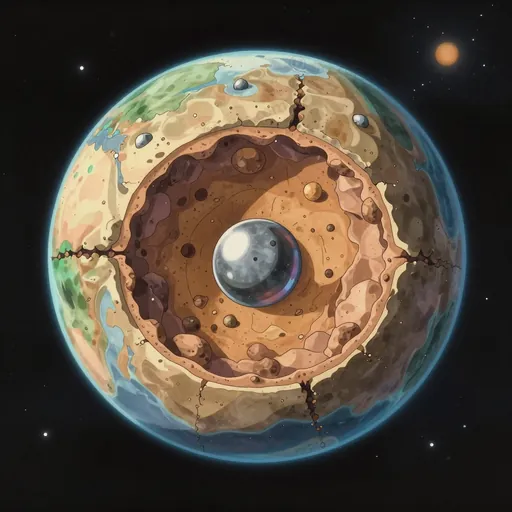
Noun: A terrestrial planet is a type of planet that is composed primarily of silicate rocks or metals. It has a solid, rocky surface, a central metallic core, and a relatively thin atmosphere compared to gas giants. In our solar system, the four planets closest to the Sun—Mercury, Venus, Earth, and Mars—are classified as terrestrial planets.
Usage
The term is used in astronomy and planetary science to categorize planets based on their physical composition and structure, distinguishing them from gas giants or ice giants.
Examples
- Mercury, Venus, Earth, and Mars are the four terrestrial planets in our solar system.
- Scientists are searching for terrestrial planets in other star systems that might have conditions suitable for life.
- Unlike Jupiter, a terrestrial planet has a defined solid surface you could theoretically stand on.
Advanced Usage
- The concept is central to planetary formation theories, where terrestrial planets form in the hotter, inner regions of a protoplanetary disk.
- The term is often used in the search for exoplanets, as in "Earth-sized terrestrial planet orbiting within the habitable zone."
Variants and Related Words
- Telluric planet: A less common synonym for terrestrial planet.
- Rocky planet: A more descriptive, informal term often used interchangeably with terrestrial planet.
- Gas giant: A contrasting type of planet, like Jupiter or Saturn, composed mainly of hydrogen and helium.
- Ice giant: A planet like Uranus or Neptune, composed largely of elements heavier than hydrogen and helium.
Synonyms
- Rocky planet
- Telluric planet
Antonyms
- Gas giant
- Jovian planet (often used for gas giants)
- Ice giant
Noun
-
a planet having a compact rocky surface like the Earth's; the four innermost planets in the solar system