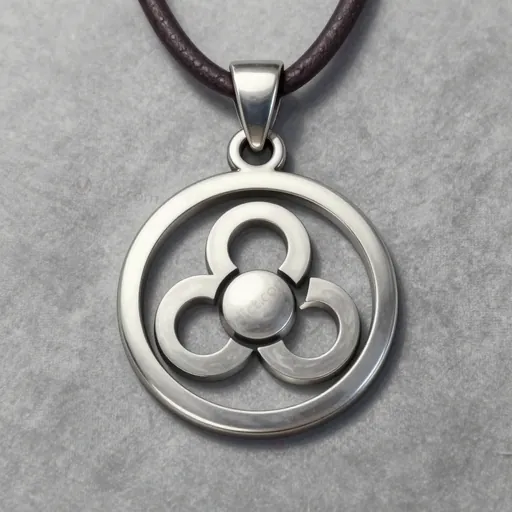
triskele
Noun: A triskele is a symbolic figure consisting of three identical, stylized human arms, legs, or bent lines (such as spirals or meanders) radiating symmetrically from a common central point. It is an ancient motif representing concepts like motion, cycles, and triplicities.
The word "triskele" is used as a countable noun to refer to this specific type of symbol, often in contexts discussing history, archaeology, art, or symbolism. * The flag of Sicily features a triskele with three bent legs. * The Celtic triskele, composed of three interlocked spirals, is a common design in ancient art. * Archaeologists found a pottery shard decorated with a triskele.
- Heraldic Charge: In heraldry, a triskele is used as a charge (a design element) on coats of arms and flags.
- The family's heraldic shield prominently displays a golden triskele.
- Symbolic Interpretation: The symbol is often interpreted to represent various triads, such as past, present, and future, or earth, water, and sky.
- For many, the triskele symbolizes the cycle of life, death, and rebirth.
- Triskelion (noun): This term is often used interchangeably with "triskele." Some sources distinguish it by suggesting a triskelion is composed of three , while a triskele is composed of three , but in common usage, they are synonyms.
- The ancient artifact was engraved with a complex triskelion.
- Triple spiral
- Threefold symbol
The word "triskele" does not have other distinct, unrelated meanings. Its definition is specific to the symbolic figure.
-
a figure consisting of three stylized human arms or legs (or three bent lines) radiating from a center
Khám phá thêm
Các từ liên quan
Từ đồng nghĩa
Từ gần giống