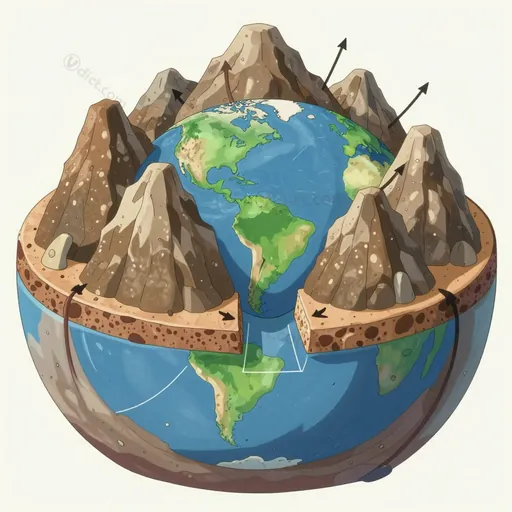
geodynamic
Definition
- Adjective:
- Relating to geodynamics: "geodynamic" describes something pertaining to the branch of geophysics that studies the forces and processes affecting the dynamics of the Earth's interior and crust, including plate tectonics, mantle convection, and crustal deformation.
Usage Examples
- (A model related to the forces and motions within the Earth.)
- (Research focused on Earth's internal dynamics.)
- (The past processes of Earth's crustal movement in that area.)
Advanced Usage
"geodynamic processes": natural mechanisms driven by Earth's internal heat and gravity.
- Volcanic activity and continental drift are examples of geodynamic processes. (These processes shape the Earth's surface over geological time.)
"geodynamic modeling": computational simulations used to study Earth's interior behavior.
- Geodynamic modeling can replicate mantle convection patterns. (Computer simulations of Earth's internal dynamics.)
Variants and Related Words
Geodynamics (n): the scientific study of the forces and processes that cause movement and deformation within the Earth.
- Geodynamics is essential for understanding plate tectonics. (The field of study itself.)
Geodynamicist (n): a scientist who specializes in geodynamics.
- The geodynamicist presented new data on subduction zones. (An expert in Earth's dynamic processes.)
Synonyms
Tectonic: relating to the structure and deformation of the Earth's crust, often used interchangeably in geological contexts.
- Tectonic forces are part of geodynamic processes. (Synonym emphasizing crustal deformation.)
Earth-dynamic: a less common synonym for geodynamic.
- Earth-dynamic studies focus on mantle convection. (Equivalent but less technical term.)
Related Idioms
- No common idioms exist for "geodynamic," as it is a technical scientific term.
Khám phá thêm
Các từ liên quan
Từ chứa "geodynamic"