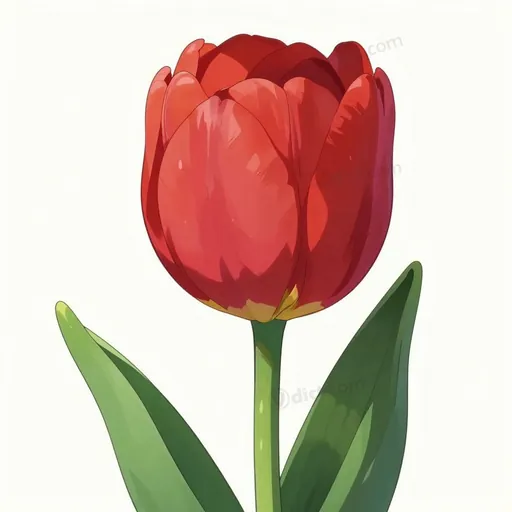
tepal
Definition
Noun: * A segment of a perianth that is not clearly differentiated into a sepal or a petal. This term is used for flowers where the outer and inner whorls of the perianth are similar in appearance, such as in lilies and tulips.
Usage
The word "tepal" is a specialized botanical term. It is used to accurately describe the floral parts of certain plant families where the typical distinction between sepals (usually green and protective) and petals (usually colored and showy) is absent.
Examples
- In many monocot flowers, the perianth is composed of six similar tepals.
- The botanist noted that the flower's perianth consisted of undifferentiated tepals rather than distinct sepals and petals.
- A tulip flower has six colorful tepals.
Advanced Usage
- The term is primarily used in scientific, horticultural, and botanical descriptions.
- It can be used in a collective sense (e.g., "the tepal whorl") or to refer to individual segments.
Variants and Related Words
- Perianth (noun): The non-reproductive part of a flower, consisting of the calyx (sepals) and corolla (petals). When these are similar, they are collectively called tepals.
- Sepal (noun): A separate part of the calyx, typically green and leaf-like.
- Petal (noun): A separate part of the corolla, typically brightly colored.
Synonyms
- Perianth segment (This is a descriptive synonym but less precise than "tepal" for undifferentiated parts).
Antonyms
- There are no direct antonyms, as it is a specific morphological term. The contrasting concepts would be the differentiated parts: sepal and petal.
Notes
- "Tepal" is a portmanteau word, blending "petal" and "sepal," which reflects its meaning.
- This word is not commonly used in everyday conversation but is standard in botanical contexts.
Noun
-
an undifferentiated part of a perianth that cannot be distinguished as a sepal or a petal (as in lilies and tulips)