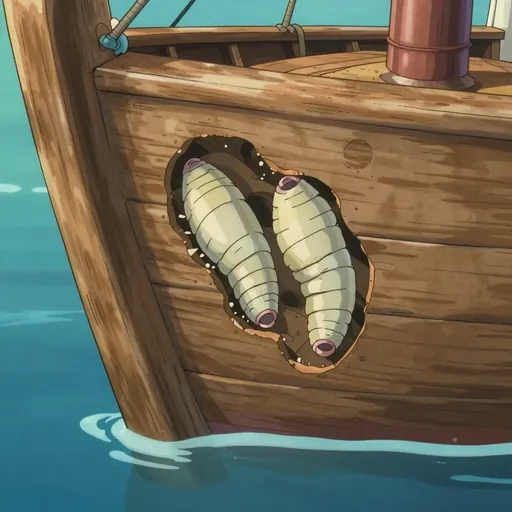
teredinid
Noun: * A wormlike marine bivalve mollusk of the family Teredinidae, commonly known as a shipworm. It is characterized by its elongated, soft body and a pair of small, drill-like shells at its anterior end, which it uses to bore into and digest wood submerged in seawater, such as wooden piers, ships, and driftwood.
The term "teredinid" is a scientific, taxonomic name used primarily in marine biology, zoology, and ecological studies. It refers specifically to the organism as a member of its biological family.
- The marine biologist studied the teredinid population to assess the biodeterioration of the historic shipwreck.
- A significant infestation of teredinids was found in the pilings supporting the old pier.
- Under the microscope, the teredinid's calcareous lining and pallets were clearly visible.
- The term is often used in technical contexts discussing marine wood-boring organisms, their impact on maritime infrastructure (bioerosion), and their unique digestive symbiosis with cellulolytic bacteria.
- It can be used attributively (like an adjective) in compound nouns, e.g., "teredinid infestation," "teredinid damage," "teredinid larvae."
- Shipworm (n): The common name for a teredinid.
- Teredo (n): A genus within the Teredinidae family; often used historically as a general term for shipworms.
- Bankia (n): Another genus within the Teredinidae family.
- Borer (n): A general term for any organism that bores into wood or other materials.
- Shipworm
- Marine borer
- Wood-boring clam
While "teredinid" is the precise biological term, "shipworm" is the universally recognized common name. It is important to note that despite the name "worm," it is not an annelid worm but a highly modified bivalve mollusk.
-
wormlike marine bivalve that bores into wooden piers and ships by means of drill-like shells
Khám phá thêm
Các từ liên quan
Từ đồng nghĩa
Từ gần giống
Từ chứa "teredinid"