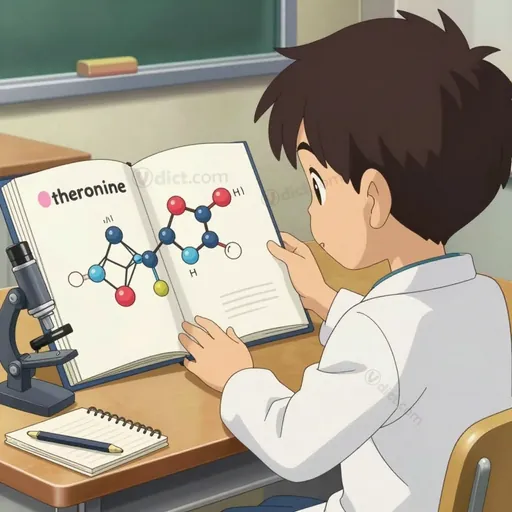
threonine
Definition
Noun: * An essential amino acid. It is a colorless, crystalline substance found in many proteins and is necessary for human nutrition and health.
Usage
- As a subject: "Threonine is one of the twenty common amino acids."
- As an object: "The body cannot synthesize threonine, so it must be obtained from the diet."
- With modifiers: "L-threonine is the form used by the human body."
Examples
- "Foods like lentils, chicken, and cheese are good sources of threonine."
- "A deficiency in threonine can affect protein synthesis and immune function."
- "The chemical structure of threonine includes a hydroxyl group."
Advanced Usage
- In biochemistry: Threonine is often discussed in the context of protein biosynthesis, metabolic pathways, and nutritional science.
- Example: "Threonine residues in a protein can be sites for phosphorylation, a key regulatory mechanism."
- In nutrition/industry: It is referred to as a dietary supplement or an additive in animal feed.
- Example: "This feed formula is fortified with additional threonine to promote livestock growth."
Variants and Related Words
- L-threonine (n): The specific, biologically active form of the amino acid found in proteins and used by organisms.
- Threonyl (adj): A biochemical term relating to or derived from threonine, often used in compound names (e.g., threonyl-tRNA).
Synonyms
- Essential amino acid: (This is its category, not a perfect synonym. Threonine is a specific type of essential amino acid.)
Notes on Meaning
This word has a single, specific scientific meaning. It does not have different general meanings, idioms, or phrasal verbs. Its usage is almost exclusively technical, within the fields of biochemistry, molecular biology, and nutrition.
Noun
-
a colorless crystalline amino acid found in protein; occurs in the hydrolysates of certain proteins; an essential component of human nutrition
Khám phá thêm
Các từ liên quan
Từ gần giống